 |
History of East Court, Finchampstead |
THE LATE 1800s - BENTINCKS, LADY OTTOLINE MORRELL, CHARLES KINGSLEY
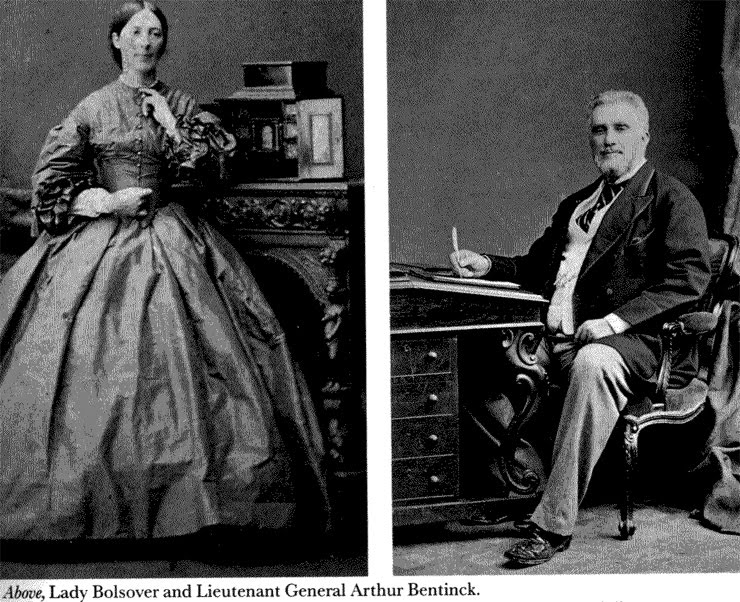
GENERAL ARTHUR CAVENDISH-BENTINCK & WIFE AUGUSTA (Later to become BARONESS BALSOVER) AND THEIR FRIEND, CHARLES KINGSLEY
During the period c1860-1878 East Court was the family home of General Arthur Cavendish-Bentinck, his wife and children. The Bentincks had befriended the Rev Charles Kingsley whilst on holiday in Scotland, and it was Kingsley (whose parish was at Eversley, just 2 miles down the road) who persuaded the Bentincks to move to the Berkshire/Hampshire border.
East Court proved the perfect country home for them, and visits between Eversley Rectory and East Court took place every week. (See Miranda Seymour’s biography of Ottoline Morrell: Life On The Grand Scale.) The young Ottoline Bentinck (to become Ottoline Morrell, the celebrated socialite) was born there and spent a happy childhood at East Court. Her great-great-uncle (through her paternal grandmother, Lady Anne Wellesley) was Arthur Wellesley, 1st Duke of Wellington, who was of course a national hero and whose estate was nearby.
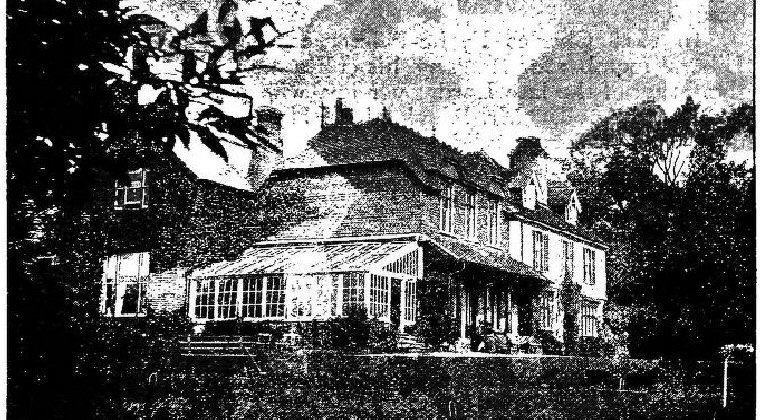
'All of the children loved East Court, a red-brick Georgian manor house which the Bentincks rented from the local Walter Family, who owned The Times. Modernised in the mid-nineteenth century, East Court had a billiard room, stained-glass representations of Tudor monarchs, a heated conservatory, and a white stucco front partly hidden behind a giant wisteria. Its views were magnificent. Some windows looked towards the nearby Norman church over a sea of firs and some down the hill through a frame of cedar branches, while others looked across the garden lawn to a landscape of undulating Berkshire meadowland.
Dominating Ottoline’s memories of East Court was the figure of Charles Kingsley. “ I used to admire him so much and loved his books” she wrote in later life, “and my mother was so fond of him”. Kingsley had been on holiday in Scotland when he first met Ottoline’s parents: it was he and his wife, Fanny Grenfell, who persuaded them to settle at East Court, less than two miles from Kingsley’s own parish at Eversley. Visits between Eversley Rectory and East Court took place every week and the Canon’s blend of candour, kindness and sportsmanship endeared him to the young Bentincks as much as to their parents. Ottoline’s mother had read all Kingsley’s works. She talked with him about his beliefs and she watched him working night and day among his sick parishioners in the bitter winter before his death in 1875.
Kingsley’s brand of Christian Socialism had considerable appeal for a woman of philanthropic inclinations. The landowning class were born to rule, in his view, but they should learn to do so with kindness and benevolence. A Dickens or a Mrs Gaskell could be relied upon to make a villain of a lord: Kingsley was concerned only that the lord should not exploit his privileged position. It was an attitude which the Bentincks of East Court warmly endorsed. Kingsley’s famous children’s story, The Water Babies, taught Ottoline the simple lesson of good behaviour… Kingsley’s message to children was to forgive their enemies, as Tom forgives Mr Grimes, and to seek happiness through acts of kindness. This pattern of active benevolence had been initiated in the nursery at East Court, and Ottoline, a highly impressionable child, absorbed the book’s message years before she discovered the writings of Thomas a Kempis, her acknowledged source of inspiration. The Water Babies had the added attraction of being set against a familiar background: Tom’s adventures take place in the glistening water meadows a few miles from East Court…
The sudden death of General Bentinck in 1877 in London brought about a shift in family relationships. Ottoline had been left behind at East Court with Nanny Powell and Charlie. When the news came to us we stood side by side at the nursery window and looked out down to the stable yard, feeling sad and solemn. ‘Papa is dead. That means he will never come back again’. His wife Augusta had no widow’s army pension, but the 5th Duke of Portland, a cousin, provided enough money for her to rent a London home in Grosvenor Crescent: East Court was to be abandoned as soon as the Walters could find new tenants.'
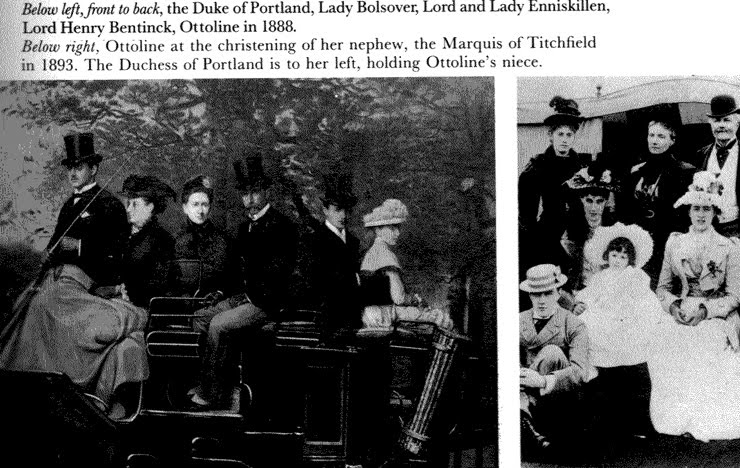
'Two years later, Ottoline’s oldest brother Arthur inherited the famous Welbeck estate on the death of the 5th Duke. The shipyard, colliery, railway, shooting estates and houses comprised a magnificent legacy: with it, the twenty-two-year-old duke became the most eligible young bachelor in England. Ottoline became ‘Lady Ottoline’ and her brother Arthur became “His Grace”, while their mother remained plain Mrs Bentinck. A delicately worded letter to the Prime Minister was despatched and cordially received by Disraeli… A reminder was dropped to the Queen… and Augusta was created Baroness Bolsover for the castle of that name which formed part of the Portland inheritance.' [Reproduced from “Ottoline Morrell: Life On The Grand Scale” by kind permission of Miranda Seymour.]
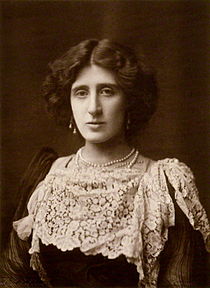
 In adulthood, Ottoline married the liberal MP Philip Morrell. As Ottoline Morrell, she was simultaneously celebrated and castigated as probably the most prominent of the early 20th century socialites known as The Bloomsbury Group. Friend, lover, supporter, hostess to a wide group of the great writers, poets and artists of the early 20th century. Confidante to Virginia Woolf, friend to D.H.Lawrence, Aldous Huxley, Siegfried Sassoon, WB Yeats and TS Eliot, and lover of Augustus John, Bertrand Russell, Dora Carrington, Dorothy Bussy, Roger Fry, and several others: she was the inspiration for Hermione Roddice in D H Lawrence’s Women in Love, and inspired similar characters in books by Graham Greene, Aldous Huxley, Some believe she was also the inspiration for DH Lawrence’s Lady Chatterley.
The 2500 letters written to her by Bertrand Russell have illuminated the mind of one of the 20th century’s great philosophers.
As her health deteriorated towards the end of her life, Lady Ottoline made a sentimental return to East Court with the 6th Duke of Portland in 1935. She died in 1938.
This portrait (above right) was painted by the celebrated artist (and her lover) Augustus John in 1919, and today it is on display in the National Portrait Gallery in London.