 |
History of East Court, Finchampstead |
EAST COURT IN THE EARLY 1800s - THE JOHN WALTER FAMILY
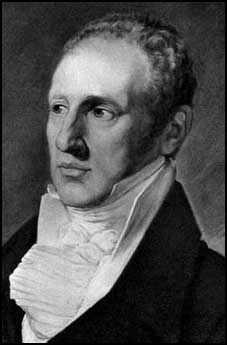
JOHN WALTER II (1776-1847)
He was a great man. In 1819 he published several articles written by John Edward Taylor and John Tyas on the Peterloo Massacre. The Times criticised the way Lord Liverpool's government was dealing with those arguing for political reform.
After the massacre The Times began to argue for parliamentary reform. By 1830 the newspaper was constantly urging the Whig government to take action. The views of the newspaper and its editor, Thomas Barnes, had a great influence on public opinion. The government tax on newspapers meant that its price of 7d. made it too expensive for most people to buy. However, copies were available in reading rooms. In 1831 the Tory St. James's Chronicle claimed that "for every one copy of The Times that is purchased for the usual purposes, nine we venture to say are purchased to be lent to the wretched characters who, being miserable, look to political changes for an amelioration of their condition."
 In Parliament the Tories complained about The Times campaign. In a debate that took place in the House of Commons on 7th March, 1832, Sir Robert Peel argued that the newspaper was the "principal and most powerful advocate of Reform" in Britain. After the 1832 Reform Act was passed the newspaper called it the "greatest event of modern history."
The Times also campaigned for the rights of trade unionists. In 1834 it became involved in what became known as the case of the Tolpuddle Martyrs. The Times condemned the decision to prosecute six farmworkers at Tolpuddle for "administering illegal oaths". The Times also supported the demands that the men should be reprieved after they were sentenced to transportation for seven years.
In 1832 Mr Walter purchased a 5000 acre estate called Bearwood, in Berkshire (where his son afterwards built the present mansion, using bricks created from clay extracted from a site within the estate). This technique of self-sufficient construction was also evident in the unusual methods employed in the enlargement of East Court in the mid-1800s. He was appointed High Sheriff of Berkshire and elected to Parliament for that county, and retained his seat till 1837. In 1841 he was returned to Parliament for Nottingham, but was unseated next year on petition. He was twice married, and by his second wife, Mary Smythe, had a family. He died in London on the 28th of July 1847.
John Walter of '"The Times" (1776-1847), campaigner against the Poor Law Commission, owned property in the area. His son, John Walter (1818 - 1894), owned East Court in Finchampstead, and, entirely at his own expense, provided the [Finchampstead] School-house from 1858-1871.* [Ed: he also endowed cottages beside St Michael’s Church Sandhurst and cottages in Bearwood Road beyond the pub known as the Walter Arms]
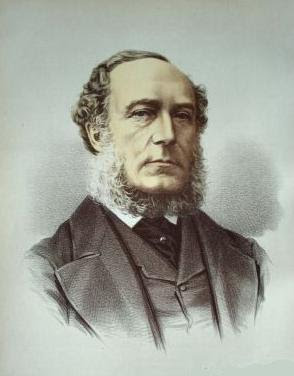
JOHN WALTER III (1818-1894)
On his father's death became sole manager of The Times, though he devolved part of the work on Mr Mowbray Morris. He was a man of scholarly tastes and serious religious views, and his conscientious character had a marked influence on the tone of the paper. It was under him that the successive improvements in the printing machinery, begun by his father in 1814, at last reached the stage of the 'Walter Press' in 1869, the pioneer of modern newspaper printing-presses.
In 1847 he was elected to Parliament for Nottingham as a moderate Liberal, and was re-elected in 1852 and in 1857. In 1859 he was returned for Berkshire, and though defeated in 1865, was again elected in 1868, and held the seat till he retired in 1885. He died on the 3rd of November 1894. He was twice married, first in 1842 to Emily Frances Court (d. 1858), and secondly in 1861 to Flora Macnabb. His eldest son by the first marriage, John, was accidentally drowned at Bearwood in 1870, trying to rescue friends at a party who had skated on, and fallen into the frozen estate lake; and he was succeeded by Mr Arthur Fraser Walter (1846-1910), his second son by the first marriage. Mr A. F. Walter remained chief proprietor of The Times till 1908, when it was converted into a company. He then became chairman of the board of directors, and on his death was succeeded in this position by his son John.
The Walters were very significant landowners in this area, owning large parts of Arborfield, Finchampstead, and parts of Eversley and Sandhurst. Their significance lay not just in their prominence in publishing and opinion-forming via The Times. William Lyon argues powerfully that, by contrast to so many large landowners, they took their Manorial obligations most seriously, and East Court was substantially enlarged, improved and extended whilst part of the Walter estate: "I cannot close this chapter without alluding to the great loss which the parish of Finchampstead has sustained by the recent lamented death of Mr. John Walter, of Bearwood. During the forty-five years of his ownership of the East Court Manor of Finchampstead, Mr. Walter has exercised a greater influence for good, and has effected greater public improvements in this parish, than can be traced in the lives of any of his predecessors in this estate. Attention has been already drawn to what Mr. Walter has done for our Churchyard, for our Parish Schools, and in making new Roads. I might also add that he contributed largely to the maintenance of our Schools, and to every other good object for which his help was needed. The East Court Manor had not enjoyed the advantage of a resident owner for more than a century until the late Mr. Fyshe-Palmer made East Court House his home early in the present century ; and although Mr. Walter did not reside upon this Manor, he seldom allowed a week to pass without visiting it and attending to his various duties connected with it. There was no part of his large property to which he was more strongly attached, and he faithfully discharged every duty connected with it.
Mr. Walter's position as a public man is so well known that there is no need to make mention of it here, further than that he sat in Parliament for thirty-five years as one of the members for the county of Berkshire and for the borough of Nottingham, between the years 1847 and 1885, and that as manager-in-chief of the ' Times ' newspaper he exercised a powerful influence in forming public opinion in England for upwards of a quarter of a century. He died November 3, 1894."
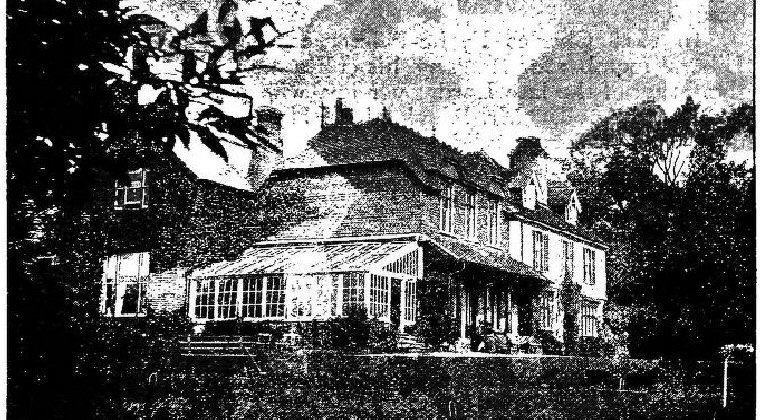
Lyon goes on to comment on the growth of East Court, compared to its earlier period when it had been known as 'Cowdries'. 'Cowderies' in 1660 and in 1807 was a very much smaller house than the present East Court House. On reference to a return of the ' Hearth Tax ' for Finchampstead about 1662 or 1663, it will be seen that it possessed only eight hearths, and this number of hearths can be accounted for in the old part of the house which still remains. If we were to omit the additions which were made to it by Mr. Charles Fyshe-Palmer in the present century, and the large dining-room and some other rooms and offices which were added by Mr. John Walter in 1870, we should then see the house as it was in the sixteenth century.
We may also compare this house with West Court House, which at that period had only seven hearths, with the old Manor House on Church Hill, and with East House, both of which had eight hearths. Our ancestors two centuries ago must have been more easily satisfied than we are in the present day, A.D. 1881 if houses with such scant accommodation as these could be correctly termed ' capital messuages.'
The above representation [at the top of the page] of East Court House (from a photograph taken by Mr. F. G. Lyon in 1894) shows the house as it is at present. It originally consisted of only half of what is seen in this picture of the front of the house, namely, the three windows to the right, and the two attic windows above. The left half was added by the last Mr. Fyshe-Palmer, and considerably improved by the present occupier.[i.e. William Lyon, the author: ed.]